

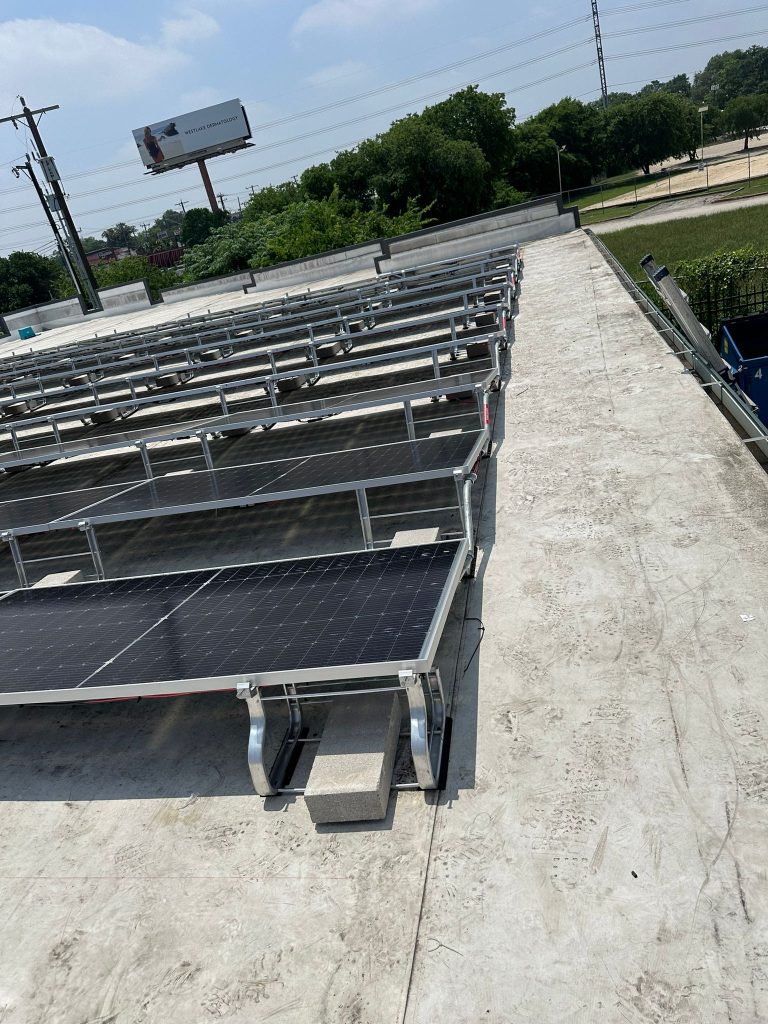
If you have solar panels on your DFW home — or you’re planning to install some — a solar battery is one of the most-asked-about upgrades. This guide answers the common questions: why add one, retrofit vs new install, costs in 2026, what gets backed up, and which brands work best for our market.
Why Add a Battery to Solar?
Solar without storage works fine for offsetting your electric bill. But you’re sending excess production to the grid (often at unfavorable buyback rates), and when the grid goes down, your solar shuts off too. Adding a battery solves both problems.
The four core benefits:
- Outage protection. When the grid fails, your battery powers your home automatically. Solar continues producing during daylight, recharging the battery. The combination handles extended outages in a way solar alone can’t.
- Self-consumption value. Texas buyback rates vary widely by retail electric provider. Some plans pay much less than retail for excess solar. A battery lets you use your own solar at night instead of selling it cheap during the day.
- Time-of-use optimization. On time-of-use rate plans, charges spike during peak hours. A battery lets you discharge during peaks and charge during off-peak hours.
- Grid independence (partial). For homeowners motivated by resilience, the combination of solar + battery dramatically reduces grid dependence. Full independence is possible with appropriate sizing.
Retrofitting vs New Install
New install (solar + battery together): Generally cleaner. A single design process, single permit, single utility interconnection. Hybrid inverter can handle both solar DC and battery DC sides natively. Federal tax credit applies to the whole system.
Retrofit (battery added to existing solar): More common in 2026 as homeowners who installed solar 2-7 years ago without batteries decide to add them. Most existing solar systems can accommodate AC-coupled battery retrofits — meaning we don’t have to replace your existing inverter, just add a battery and battery inverter in parallel.
Retrofit installs typically take 1-2 days for the physical work. The system controller handles automatic switchover between grid, solar, and battery.
Cost of a Solar Battery in 2026
DFW market pricing for solar battery installations:
- Single battery unit (~13-15 kWh) added to existing solar: $13,000-$18,000
- Two units (~28-30 kWh) added to existing solar: $22,000-$32,000
- Three units (~42-45 kWh): $32,000-$45,000
The 30% federal tax credit applies to battery storage — including retrofits to existing solar systems. So a $15,000 battery install effectively costs $10,500 after the credit.
What drives cost variation:
- Battery capacity (more kWh = more cost)
- Single vs whole-home backup
- Whether a service panel upgrade is needed
- Existing inverter compatibility (sometimes a hybrid inverter swap makes economic sense)
- Installation complexity
Backup Loads: What Will Stay Powered
This is where sizing decisions matter. With limited battery capacity, you can’t power everything in your home indefinitely. You’re prioritizing what stays running during an outage.
Critical loads typically include:
- Refrigerator and freezer
- Internet router and modem
- Furnace fan (gas heat)
- Sump pumps
- Lighting (LED only)
- Phone chargers and key outlets
- Garage door opener
Loads that drain batteries fast (usually excluded from essential-loads backup):
- Central air conditioning (huge draw)
- Electric water heaters
- Electric ranges and ovens
- Electric vehicle chargers
- Pool pumps
- Dryers (electric)
A typical 12-15 kWh battery system can power critical loads for 12-24 hours. Whole-home backup including AC requires substantially more capacity — usually 30+ kWh.
A good installer walks through your specific home, identifies which loads matter to you during an outage, and sizes accordingly.
Top Battery Brands We Install
In the DFW market in 2026, the brands that consistently deliver good results:
FranklinWH aPower 2 — 15 kWh per unit, stackable, LiFePO4 chemistry, strong load management. Our most-installed battery for whole-home and essential-loads backup.
Tesla Powerwall 3 — 13.5 kWh, integrated solar inverter, well-known brand and app.
Enphase IQ Battery — Modular (3.5, 5, 10 kWh units), particularly good fit if you have Enphase microinverter solar.
Other Tier-1 brands offer comparable specs. Selection should match your home’s specific needs rather than brand preference.
Texas Net Metering Considerations
“Net metering” in Texas isn’t standardized like in some states. Each retail electric provider sets their own buyback policy. Some pay full retail rate for excess solar production. Others pay much less (sometimes only the wholesale generation rate). Some don’t offer buyback at all.
Why this matters for batteries: if your buyback rate is unfavorable, the value proposition for batteries strengthens significantly. You’d rather use your own solar production at night than sell it cheap during the day. A battery captures that value for you.
Conversely, if you’re on a generous full-retail buyback plan, the economics of self-consumption shift. You might still want a battery for backup power, but the financial case is different.
A good consultation walks through your specific retail electric provider plan and the implications for battery economics.
Common Questions
Will my solar system work the same with a battery added? Yes. The solar continues to operate normally. The battery just adds storage and backup capabilities.
Do I need a new inverter? Usually not — for AC-coupled retrofits, your existing inverter stays. For some installations, swapping to a hybrid inverter makes long-term sense.
Where does the battery go? Most commonly in the garage, utility room, or outdoor wall (in rated enclosures). Sizing varies but most units are about the size of a small dishwasher.
How loud is it? Nearly silent. Modern batteries have small cooling fans that only run when needed.
What about Texas summer heat? Modern batteries are rated for Texas conditions, but installation location matters. Garage installations are typically fine. Some homeowners opt for climate-controlled installation locations for extreme longevity.
Getting Started
If you’re considering adding a solar battery to your DFW home — whether retrofit or new install — start with a free site assessment. We’ll evaluate your existing solar (if any), your home’s electrical setup, your backup priorities, and your retail electric provider plan, then recommend a specific battery sized appropriately.
We install across the DFW metroplex. Reach out for honest answers about whether a battery makes sense for your home, and what it would cost.