

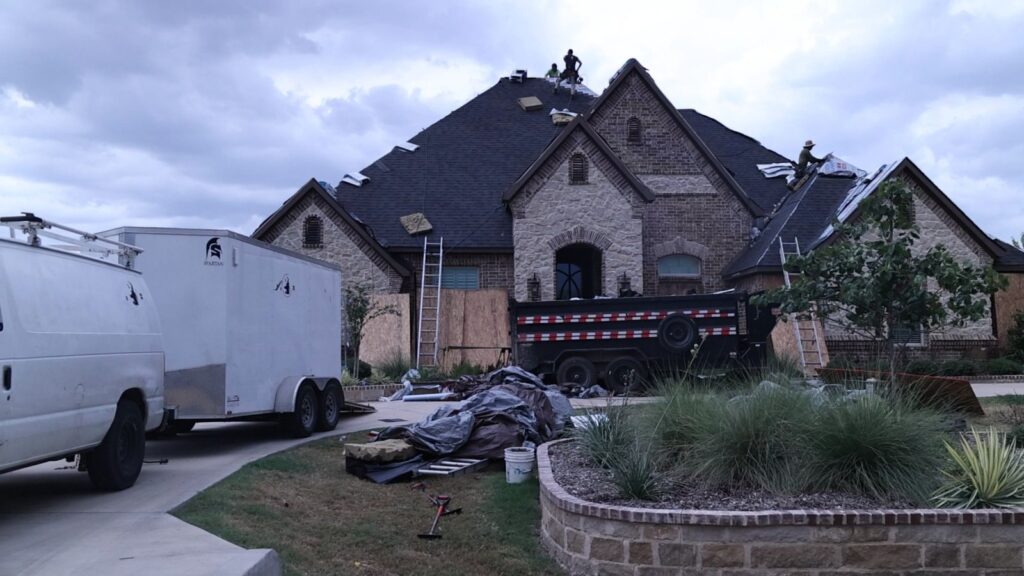
Usually not, if you are only replacing shingles on a single-family or two-family home inside Fort Worth city limits. The City of Fort Worth’s residential re-roofing FAQ says a shingle-only replacement with no decking replaced does not need a permit, but a permit is required if any decking is replaced. Code rules such as drip edge and crickets still apply either way, so confirm with the city before work starts.
That short answer hides a few traps. Decking damage is often discovered only after the old shingles come off, your address may not actually be inside Fort Worth city limits, and “no permit” does not mean “no rules.” This guide walks through what the city’s FAQ says as of October 2026, how it compares with Dallas and the suburbs, and what to ask your roofer before the tear-off begins.
What does Fort Worth’s roofing FAQ actually say about permits?
The city’s FAQ answers two permit questions directly. For a replacement roof on a single-family or two-family dwelling where only shingles are replaced and no decking is replaced, the answer is no permit. If any decking is replaced, the answer is yes. The FAQ is undated, so confirm it is still current.
You can read the two-page document yourself on the City of Fort Worth residential re-roofing FAQ. It was written to answer common questions from residents, roofing companies and insurance companies, and it covers more than permits. Here is a plain-English summary of the main points as we read them in October 2026:
| Question | What the city FAQ says |
|---|---|
| Shingle-only reroof, 1–2 family home, no decking replaced | No permit required |
| Any decking replaced | Permit required |
| Drip edge missing on the old roof | Required when re-roofing |
| Crickets missing on the old roof | Required when re-roofing |
| Ice barrier underlayment | Not required under the city’s local amendments |
| Underlayment type | Manufacturer instructions or 2021 IRC section R905, whichever is more restrictive |
| New decking laid over old decking | Not allowed |
| Code chapter for roof assemblies | Chapter 9 of the 2021 International Residential Code |
Treat this table as a starting point, not legal advice. Fort Worth updates its adopted codes and local amendments over time, and the city’s construction codes page is the place to check what is currently adopted. If anything about your project is unusual, call Fort Worth Development Services and ask before work starts.
Why does replacing decking trigger a permit?
Decking, also called sheathing, is part of the roof structure, not just the weather surface. Once boards or panels come out, the job involves how the roof is fastened and supported, which is why the city’s FAQ says a permit is required if any decking is replaced, even a small section.
This is where many Fort Worth projects get tricky. A roofer can estimate decking condition from the attic and from soft spots on the surface, but the real picture appears only after tear-off. Hail, old leaks and poor attic ventilation can leave panels delaminated or rotted in spots no one could see from below.
Before you sign, ask your roofer three things:
- How will you handle it if you find damaged decking mid-job, and who pulls the permit if one is needed?
- How is decking replacement priced (per sheet or per square foot), and is that price in the written contract?
- Will you photograph any damaged decking before replacing it, so I have a record?
Good answers are specific and written down. A vague “we’ll take care of it” leaves you exposed to a surprise bill or to work done without the permit the city’s FAQ calls for.
Does “no permit” mean the roof doesn’t have to meet code?
No. The FAQ states that the city enforces its adopted International Codes, and it lists requirements that apply when re-roofing whether or not a permit is pulled, including drip edge and crickets where they don’t currently exist. A permit-free job still has to be built to code.
A few code points from the FAQ are worth knowing as a homeowner:
- Drip edge. If your current roof has none, the FAQ says drip edge is required when you re-roof. It protects the deck edge and helps water clear the fascia.
- Crickets. A cricket is a small peaked diverter behind a chimney or other wide penetration. The FAQ says it is required when re-roofing if one does not exist.
- Underlayment. The type depends on the roof covering. The stricter of the manufacturer’s instructions or 2021 IRC section R905 applies.
- No ice barrier requirement. The city’s amendments do not require ice barrier underlayment, citing no history of ice damming locally.
- Existing sheathing. If the roof met code when built and the sheathing is in good condition, the FAQ says it does not have to be replaced just because codes changed. It also says new decking may not be installed over an existing layer.
Following the manufacturer’s installation instructions also matters for your shingle warranty. Ask your roofer to show you the manufacturer’s requirements for the product you choose.
Is my home actually inside Fort Worth city limits?
Not always. A Fort Worth mailing address does not guarantee your home is inside Fort Worth city limits. Parts of north Tarrant and south Denton counties carry Fort Worth ZIP codes but sit in other cities or unincorporated areas, and each jurisdiction sets its own permit rules.
The easiest check is your property tax account. The Tarrant Appraisal District (or the Denton Central Appraisal District, if you are in Denton County) lists the taxing jurisdictions for your parcel. If “City of Fort Worth” is on the list, the city’s rules apply. If you see another city, such as Haslet, Keller or Saginaw, check with that city’s building department instead.
If your home is in an unincorporated area, county rules and any HOA requirements may be all that apply, but ask the county before assuming nothing is needed.
How do Fort Worth’s rules compare with Dallas and the suburbs?
They differ quite a bit. Fort Worth’s FAQ exempts shingle-only reroofs on 1–2 family homes, while Dallas requires a permit when roofing work exceeds $500, pulled by a city-registered roofing contractor or the homestead owner. Suburbs set their own rules, so check with each city’s building department.
| City | Typical residential reroof rule (as of Oct 2026) | Where to confirm |
|---|---|---|
| Fort Worth | No permit for shingle-only 1–2 family reroof; permit if any decking is replaced (per city FAQ) | Fort Worth Development Services |
| Dallas | Permit when roofing work exceeds $500; pulled by a city-registered roofing contractor or homestead owner | Dallas Development Services guide |
| Keller, Haslet, Saginaw and other suburbs | Varies by city; do not assume Fort Worth’s rule applies | Your city’s building department |
If you own rental property in more than one city, or you are comparing bids from roofers who work across the metroplex, this is a good question to ask every bidder. A roofer who works in your city regularly should know the local rule without guessing.
What about HOAs, insurance and hail-resistant shingles?
An HOA approval is separate from a city permit. Many DFW associations require architectural approval for roof color or material even when the city requires no permit. Your insurer also cares about the details: an impact-resistant roof can qualify for a premium discount if documented correctly.
A few points to plan for:
- HOA review. Check your deed restrictions and submit any required application before the job is scheduled. Texas Property Code §202.011 generally limits an HOA’s ability to prohibit wind- and hail-resistant, energy-efficient or solar shingles, but it allows conditions such as requiring them to resemble shingles already used in the subdivision.
- Impact-resistant discount. Many Texas insurers offer discounts for impact-resistant roofs rated under UL 2218, Class 1 through Class 4, with Class 4 earning the highest credit. The amount is set by each insurer.
- Paperwork. To claim that discount, the roofer typically signs TDI form PC068, the roofing installation certificate. Ask for it at the end of the job and send it to your insurer.
North Texas sees enough hail that the impact-resistant question is worth asking on any Fort Worth reroof. Texas led the country in hail damage claims again in 2025, and State Farm alone reported paying about $1.4 billion in Texas hail claims that year.
What should a Fort Worth homeowner do before the tear-off?
Confirm your jurisdiction, read the city FAQ, get a written contract that covers decking and code items, handle HOA approval, and decide on impact rating before ordering materials. Those steps usually take only a few days and prevent most mid-job surprises.
- Check your appraisal district account to confirm you are inside Fort Worth city limits.
- Read the city’s roofing FAQ and call Development Services if anything is unclear.
- Get a written contract listing drip edge, crickets, underlayment, ventilation and decking pricing.
- Agree in writing on who pulls a permit if decking needs replacing.
- Submit HOA paperwork early if your neighborhood requires it.
- Choose your shingle impact rating and ask for form PC068 at completion.
If insurance is paying for part of the job, remember that Texas law requires you to pay your own deductible, and a roofer may not offer to waive or absorb it. The Texas Department of Insurance explains the rules on its roofing and insurance page.
You can see how Prometheus Power Solutions approaches a full tear-off on our roof replacement services page. If you are also thinking about panels, it is usually smarter to replace an aging roof first and then add solar, so the array doesn’t have to come off for a reroof a few years later.
If you live in north Fort Worth or nearby and want a second set of eyes on your roof, permit questions included, reach out to our team and we’ll walk through what your project likely needs.
Prometheus Power Solutions · Fort Worth, TX
Storm damage or an aging roof?
Get a straight answer from a local Fort Worth roofing team: what we find, what it should cost and what your options are.
Book a Free ConsultationCall 817-523-9029
★★★★★ 5.0 on Google · Serving all of Dallas–Fort Worth
Frequently Asked Questions
Do I need a permit to replace shingles in Fort Worth?
Per the City of Fort Worth’s roofing FAQ, no permit is required to replace only the shingles on a single-family or two-family home when no decking is replaced. Confirm with Fort Worth Development Services before work starts, since rules can change.
When is a roofing permit required in Fort Worth?
The city’s FAQ says a permit is required if any decking is replaced. Because damaged decking is often found only after tear-off, agree in writing on who will pull the permit if that happens.
Does Fort Worth require drip edge on a new roof?
Yes. The city’s roofing FAQ says drip edge is required when re-roofing if it does not currently exist, and the same is true for crickets behind chimneys and similar penetrations.
My address says Fort Worth. Do Fort Worth’s permit rules apply to me?
Only if your home is inside Fort Worth city limits. Check the taxing jurisdictions on your Tarrant Appraisal District or Denton Central Appraisal District account; if another city is listed, follow that city’s building department rules.